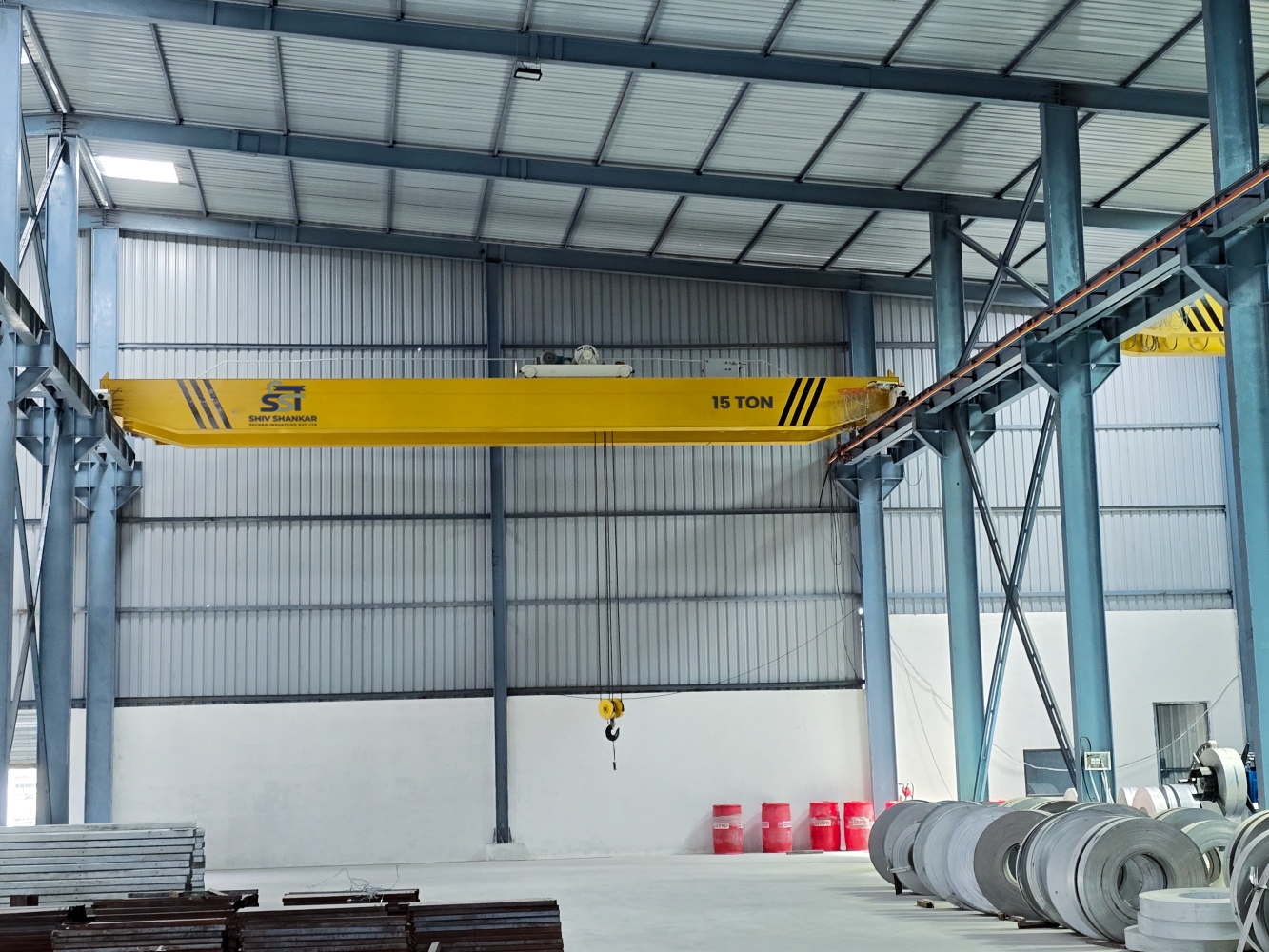
Factory-fabricated steel warehouses, designed to your span and height requirements, and erected across India with a full turnkey delivery model faster, cheaper, and more expandable than conventional construction.
India's warehousing capacity has been growing fast GST consolidation, e-commerce expansion, and the push to develop dedicated freight corridors have all created demand for large, column-free storage spaces that can be built and occupied quickly. That's exactly where PEB warehouse construction wins, every time.
A pre-engineered warehouse is a steel building where every structural component like primary frames, purlins, girts, roof sheets, wall cladding, and accessories is designed in software, fabricated in a factory, and transported to the site for bolt-together assembly. There is no wet concrete work for the superstructure, no waiting for curing, and no dependency on large on-site labour gangs. The building goes up fast and is ready for racking, shelving, and operations shortly after.
Shiv Shankar Techno Industries Pvt. Ltd. is a Chittorgarh-based PEB warehouse construction company in India that has completed 500+ projects across 25+ Indian states. We handle the full scope structural design, fabrication, logistics, foundation coordination, and site erection under a single contract.
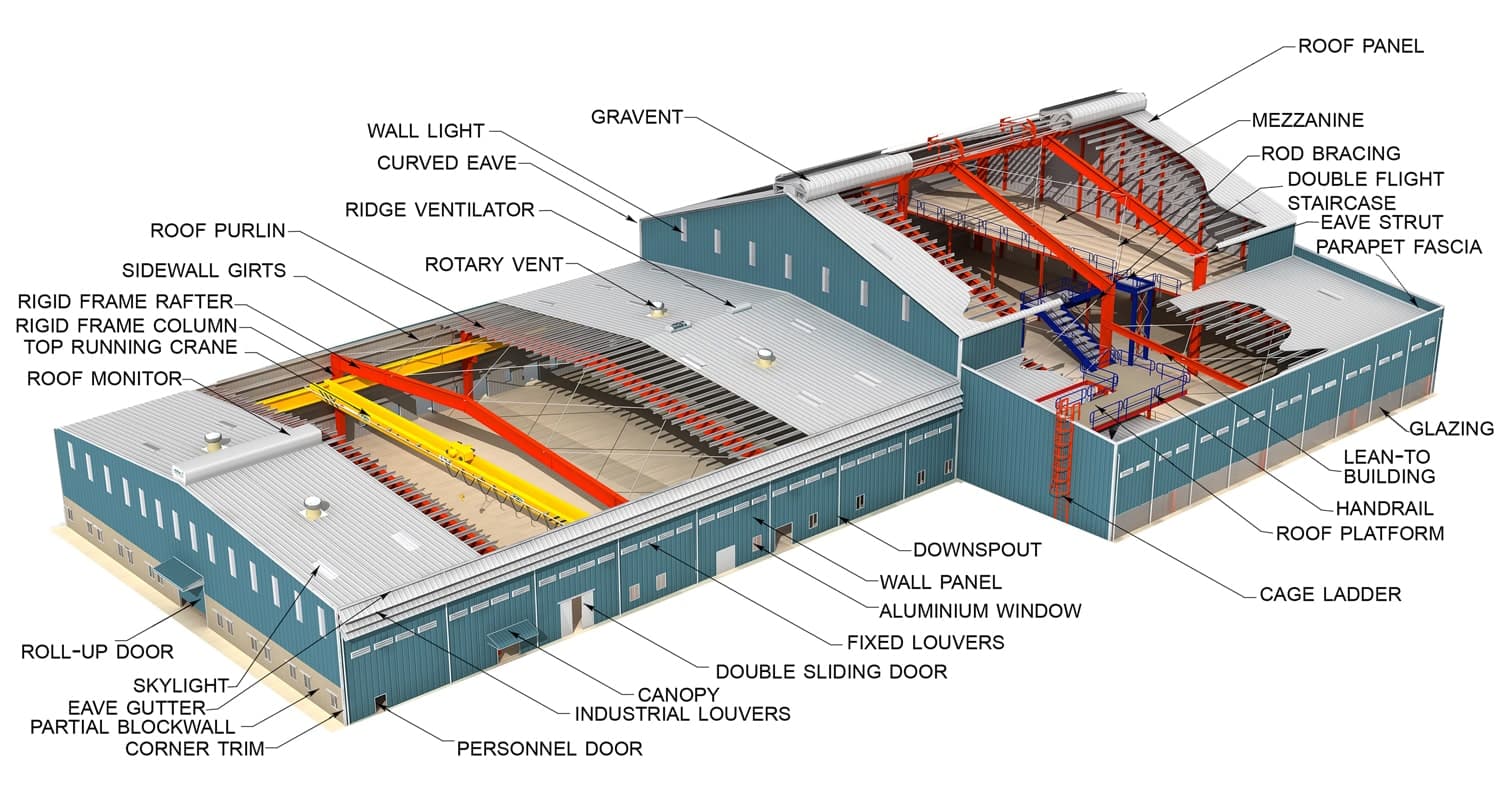
Most PEB companies can put up a shed. We engineer the complete warehouse structure, crane infrastructure, insulation system, and access provisions as an integrated design from the start.
Our structural engineers design every PEB warehouse in-house from load calculations and 3D modelling to shop drawings and BOM generation. The same company that designs your warehouse fabricates it and erects it. No outsourcing, no communication gaps between design and execution.
Because we also manufacture EOT cranes and gantry cranes in-house, we can design your warehouse structure and crane runway system together with no retrofitting, no separate vendor for crane provisions. This matters a lot for manufacturing warehouses, cold chain hubs, and heavy goods storage.
Our fabricated warehouse components are manufactured in Chittorgarh and shipped to project sites across India. Dedicated erection teams with experience across Rajasthan, Gujarat, Maharashtra, MP, UP, Karnataka, and Tamil Nadu handle the site work. Warehouse construction timelines are tight and we plan logistics to match them.
All pre-engineered warehouse buildings are designed to IS 800, IS 875 (wind and live loads), and IS 1893 (seismic). Structural drawings are signed by qualified engineers and can be submitted to RIICO, industrial area authorities, and municipal bodies for statutory plan approval.
Our PEB warehouses can be fitted with PUF or Rockwool insulated sandwich panels, ridge ventilators, translucent roof sheets for daylighting, and Galvalume roofing all specified based on your location's temperature profile and the nature of goods being stored. We don't apply the same cladding spec to every project.
Every steel warehouse we build is designed with future expansion in mind. End-wall columns and foundation pads are pre-planned for bay additions. When your storage requirement grows, adding bays to an existing PEB warehouse takes weeks, not months and rarely disrupts operations inside.
Warehouse requirements vary a lot depending on what you're storing, how you're handling it, and the scale of your operation. We've built prefabricated warehouses across most of these categories and know the design differences that matter for each.
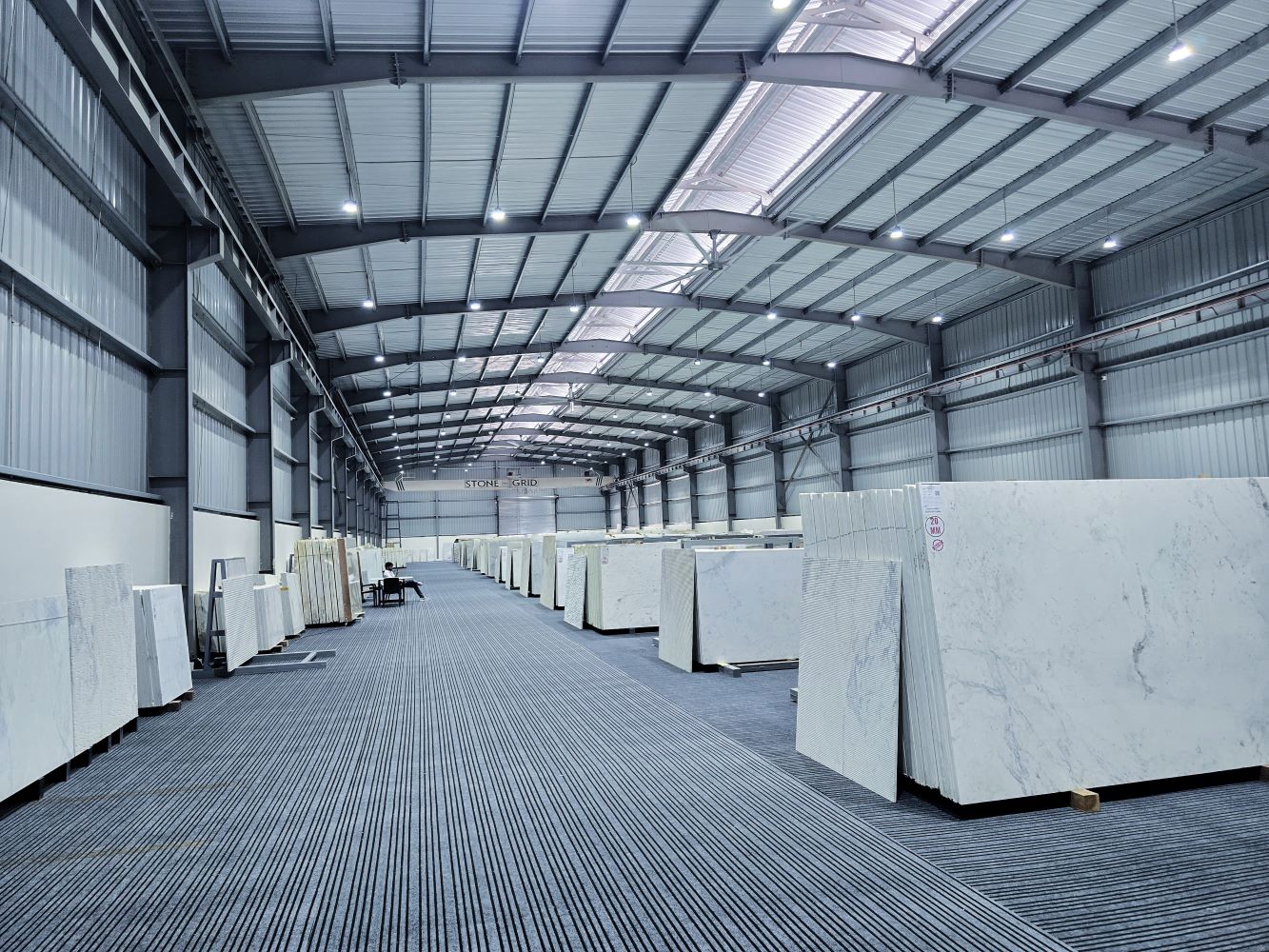
These are the standard configurable parameters for any pre-engineered warehouse building. Every project starts with these inputs then the structural design and BOM flow from them.
Single spans from 9 metres to 100+ metres, column-free. Multi-bay configurations for unlimited total width using interior columns where headroom and operations allow.
4 to 20+ metres depending on racking height, crane hook height, and statutory requirements. Taller eave heights increase usable storage volume without increasing floor footprint.
Standard bay lengths of 6 to 9 metres. Custom bay spacing to match pallet rack module dimensions, forklift turning radii, or dock door spacing requirements.
Galvalume colour-coated sheets, PUF sandwich panels (50–150mm), Rockwool panels, or polycarbonate skylights. Roof slope from 1:10 to 1:5 depending on rainfall and drainage requirements.
Colour-coated steel cladding sheets, insulated sandwich panels, or partial masonry infill. Warehouse cladding spec depends on thermal requirements, wind zone, and security requirements.
Roller shutter doors (manual or motorised), dock shelters, loading bays, personnel doors, and ventilation louvres all integrated into the structural framing from the design stage itself.
Intermediate steel-deck mezzanines for office space, sortation levels, utility rooms, or secondary storage is engineered as part of the primary PEB frame, not as an afterthought.
EOT crane runway beams, bracket plates, and column knee braces designed in-house by our crane team for capacities from 1 ton to 50+ tonns co-engineered with the warehouse PEB structure.
IS 800 (steel design), IS 875 Parts 1–3 (dead, live, wind loads), IS 1893 (seismic zones II–V). Wind and seismic parameters site-specific not generic national averages.
If you've built a factory or warehouse before using conventional construction, you know how long it takes. RCC frames, shuttering, curing cycles, block masonry none of that is on a tight schedule. A pre-engineered warehouse building removes most of that from your critical path.
The PEB components arrive pre-fabricated and ready to bolt. A 5000 sq. ft. warehouse construction that would take 8–12 months in RCC typically takes 8–12 weeks in PEB. Your goods go in faster, your lease or EMI starts paying back sooner.
For industrial areas in Rajasthan like Bhiwadi, Neemrana, Jaipur RIICO, and Chittorgarh where plots are rectangular, ground conditions are predictable, and the labour pool is available PEB warehouse construction is the most practical route to a production-ready facility.
| Parameter | PEB Warehouse | RCC Warehouse |
|---|---|---|
| Construction Time | 6–16 weeks | 8–18 months |
| Cost vs RCC | 25–35% lower | Higher |
| Column-Free Span | Up to 100+ m | Limited |
| Future Expansion | Modular bay adds | Difficult, costly |
| Insulation Options | PUF / Rockwool panels | Retrofit needed |
| Floor Load Capacity | High (RCC slab) | High (RCC slab) |
| Crane Compatible | Yes, co-engineered | Possible, retrofit |
| Relocatable | Yes | No |
| Maintenance | Low | Moderate |
Our warehouse construction process runs in defined phases. Here's what happens between your first call and the day you move goods in.
We discuss your storage needs, operational layout, crane requirements, and site conditions. A detailed project estimate covering structure, cladding, and erection is prepared with no vague ballpark figures.
After order confirmation, our engineers prepare PEB warehouse structural drawings, shop drawings, and BOM. Foundation load drawings are shared with your civil contractor for concurrent foundation work.
All primary frames, secondary members, and cladding panels are fabricated at our Chittorgarh plant under strict quality control. Steel is sourced from accredited mills with mill certificates. Components are surface treated and dispatched to site as per the erection sequence.
Our experienced erection crew bolts up the prefabricated warehouse structure, installs roofing and wall cladding, fits accessories, and does final inspection. Handover includes as-built drawings and warranty documentation.
Across our 500+ warehouse and PEB construction projects in India, these are the sectors that come back to us repeatedly and the storage challenges they bring.
Large bay-count warehouses with dock levellers, fire suppression zones, and high racking from 20,000 to 100,000 sq. ft. common size range.
Fast-built PEB warehouses with mezzanines for pick-and-pack, conveyor pits, and high bay racking. Go-live timelines are tight; we meet them.
Attached or standalone industrial storage warehouses with crane bays for raw material and finished goods handling. Often combined with a factory shed in the same compound.
Ventilated prefabricated warehouse sheds for grain, pulses, horticulture, and cold chain storage with appropriate floor treatments and anti-condensation provisions.
Insulated PEB warehouse buildings with temperature control compatibility, chemical-resistant flooring specs, and hazardous goods segregation provisions.
Wide-span steel warehouses with crane provisions for component and finished vehicle storage, plus easy future expansion as production volumes increase.
A PEB warehouse is a pre-engineered steel building where every structural component — primary frames, purlins, girts, roofing, and wall cladding — is factory-fabricated and bolted together on site. Unlike conventional RCC warehouses, there is no shuttering, no concrete curing, and no wet masonry work for the superstructure. The result is a warehouse construction timeline that is 40–50% shorter and a total cost that is typically 25–35% lower than RCC equivalents, with no compromise on structural safety.
A standard pre-engineered warehouse takes 6 to 16 weeks from confirmed order to handover, depending on the size, span, insulation system, and your site location. Foundation work runs concurrently with fabrication at our plant, which is the main reason PEB warehouse construction timelines are so much shorter than RCC. For large-footprint warehouses above 50,000 sq. ft., we discuss a detailed project schedule before order confirmation.
The cost of a PEB warehouse building in India depends on span, eave height, bay count, roofing and cladding spec, crane provisions, insulation level, and the site location. As a general benchmark, pre-engineered warehouse construction costs 25–35% less than a comparable RCC warehouse. Contact Shiv Shankar Techno with your dimensions, height, and operational requirements for a detailed, itemized project estimate.
Yes. PEB warehouse structures work well as the primary steel frame for cold storage facilities. We use PUF insulated sandwich panels — typically 80mm to 150mm thickness — for roofing and walling, which provide the thermal envelope required for food, pharma, or chemical cold chain operations. Our scope covers the steel structure and insulated envelope; refrigeration plant and evaporators are typically coordinated with a specialist cold room contractor.
Yes. Shiv Shankar Techno is a pan-India PEB warehouse construction company. Our Chittorgarh facility fabricates the components, which are shipped to sites across India. We have completed warehouse and PEB projects across Rajasthan, Gujarat, Maharashtra, Madhya Pradesh, Uttar Pradesh, Karnataka, Tamil Nadu, Telangana, Punjab, and 15+ other states. Our erection teams travel to the project site.
Absolutely — and this is actually one of the strongest use cases for pre-engineered warehouse construction. Column-free spans up to 100+ metres allow full utilization of high-bay racking systems and wide forklift aisles. Dock levellers, roller shutters, conveyor pits, and mezzanine floors for pick-and-pack can all be integrated from the design stage. And because the steel warehouse goes up in weeks rather than months, it aligns well with the tight go-live timelines that e-commerce and 3PL operations typically work with.
Yes — and this is one of the practical reasons many growing businesses choose PEB warehouse construction over RCC. Because the structure is modular, adding bays at the endwall is straightforward. End-wall columns and foundation pads can be pre-planned during original construction to make future expansion simpler. Bay additions typically take a few weeks and rarely require shutting down operations in the existing warehouse area.
Yes. All pre-engineered warehouse buildings from Shiv Shankar Techno are designed to IS 800 (structural steel), IS 875 Parts 1–3 (dead, live, and wind loads), and IS 1893 (seismic design). Wind and seismic parameters are applied site-specifically based on the project location's wind zone and seismic zone — not generic national defaults. Structural drawings prepared by our engineers can be submitted to RIICO, industrial area authorities, and municipal bodies for statutory building plan approvals.
 Chat with us